Future Architecture
Learn AI▼Resources▼AI Watch▼Tools▼
Future Architecture
Future Architecture
Future Architecture

The community of architects learning AI by doing — to spend less time on admin and more on design.

AI for AEC

  • AI Tools
  • AI Use Cases
  • AI Concepts
  • AI Tutorials

Learn & Practice AI

  • Courses
  • Workshops
  • Webinars
  • Memberships
  • Clients and partners
  • Claude Skills

Future Architecture

  • Support Future Architecture
  • Subscribe on YouTube
  • Connect on LinkedIn
  • Follow on Instagram

SuperArchi

  • AI Meeting Minutes
  • AI Tender Management
  • AI Knowledge Base
  • AI Price Database

Legal

  • Terms of Sale
  • Legal Notice
  • Privacy Policy
  • Refund Policy
  • Cookie Policy

© 2026 Future Architecture. All rights reserved.

Connect:

← Back to blog posts

Architects who master AI are getting ahead
Sep 3, 2026
Architects who master AI are getting ahead

Archive of the newsletter sent on 03/09/2026. Announcements and offers reflect that date.

I hope your return to work is going well.

In this week's newsletter:

  1. Architects are starting to take AI seriously.
  2. A free workshop to structure your AI plan.
  3. Most architects are only using a fraction of AI's potential.

1. Architects are embracing AI this September

The season has started strongly. Over the past few days, I've been struck by the number of practices contacting me to move forward with AI.

It feels very different from 2025, when AI was something people kept an eye on from a distance. Practices used to tell me they hardly used it.

This week, someone I met during training emailed me: "Could you help us improve our practice's productivity with AI?"

That made me happy.

For three years, I've been helping dozens of practices and hundreds of architects implement AI, and I can see this change taking shape in the field.

To me, it signals a growing maturity. The question is becoming how to structure AI so it delivers real benefits, rather than remaining an occasional experiment.

Many people already use AI to write emails, research topics and sometimes organise meeting minutes. But many practices lack structure: everyone has their own methods, and work that has already been done is hard to find.

There is a clearer way to organise the context we give AI: identify the processes involved and the data it needs to do the job properly.

👉 Want to clarify your AI strategy or automate a particular use case? Book a discovery call.

2. A free workshop to structure your AI plan

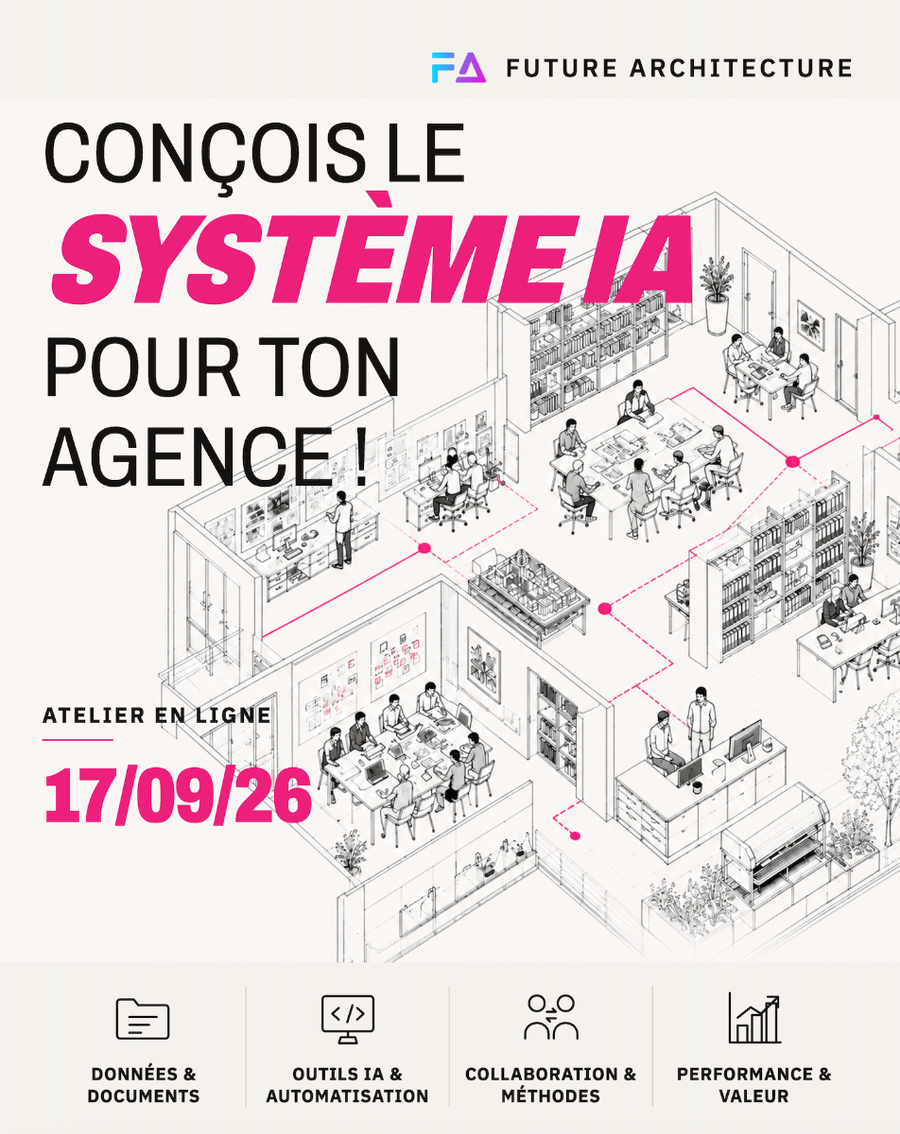
That is the subject of my next free ninety-minute workshop, on 17 September at 1:30 pm.

We'll work together to identify use cases that make sense for you. You won't leave with a magic formula to automate everything immediately. You will have taken time to clarify your AI strategy.

We'll work directly on your practice's processes: meetings, reports, document analysis, project management, design, site work, administration and communication.

You'll map the practice's main tasks, identify where AI could make a real difference and discover use cases suggested by the other participants.

The aim is to leave with priority use cases and an initial action plan for the next three months.

In ninety minutes, you can move from "We should use AI more" to "This is exactly what we're going to implement."

👉 Reserve your place at the workshop.

3. Moving beyond a small fraction of AI's potential

Next week, I'm launching my complete Claude training course.

When I launched the Claude skills pack for architects in May, it was very well received. That suggests many architects want to move beyond using Claude as a simple chat interface.

But things have moved quickly. If you feel overwhelmed, that's understandable. Many concepts introduced by Claude and then adopted by ChatGPT may still be unclear to you and your team.

In the original newsletter, I described this as architects using AI at "10% of its potential": mainly for research and emails.

To address that gap, I'm creating a complete course on building AI agents to work on essential but time-consuming architectural tasks.

The first part covers setting up Claude and using its new 2026 capabilities. The second focuses on architectural use cases through short videos, with the processes and tools I use myself every day.

It's the course I wish I'd had when I started: direct and practical, without spending time on things that won't help.

Thank you to everyone who answered this week's survey. It helped identify the use cases architects want most, and they weren't all the ones I expected.

👉 You can still answer the survey here.

I'll share more next week.

Sébastien

Questions? Email me.

Sébastien Lucas — Future Architecture

I help architects save time with AI, not replace them!

Most popular pack

Your AI assistants for architects, ready to use

The AI Assistants for Architects pack bundles our best prompts and workflows for Claude, Midjourney, and Revit.

← Back to blog posts

Architects who master AI are getting ahead

Sep 3, 2026
Architects who master AI are getting ahead

Archive of the newsletter sent on 03/09/2026. Announcements and offers reflect that date.

I hope your return to work is going well.

In this week's newsletter:

  1. Architects are starting to take AI seriously.
  2. A free workshop to structure your AI plan.
  3. Most architects are only using a fraction of AI's potential.

1. Architects are embracing AI this September

The season has started strongly. Over the past few days, I've been struck by the number of practices contacting me to move forward with AI.

It feels very different from 2025, when AI was something people kept an eye on from a distance. Practices used to tell me they hardly used it.

This week, someone I met during training emailed me: "Could you help us improve our practice's productivity with AI?"

That made me happy.

For three years, I've been helping dozens of practices and hundreds of architects implement AI, and I can see this change taking shape in the field.

To me, it signals a growing maturity. The question is becoming how to structure AI so it delivers real benefits, rather than remaining an occasional experiment.

Many people already use AI to write emails, research topics and sometimes organise meeting minutes. But many practices lack structure: everyone has their own methods, and work that has already been done is hard to find.

There is a clearer way to organise the context we give AI: identify the processes involved and the data it needs to do the job properly.

👉 Want to clarify your AI strategy or automate a particular use case? Book a discovery call.

2. A free workshop to structure your AI plan

That is the subject of my next free ninety-minute workshop, on 17 September at 1:30 pm.

We'll work together to identify use cases that make sense for you. You won't leave with a magic formula to automate everything immediately. You will have taken time to clarify your AI strategy.

We'll work directly on your practice's processes: meetings, reports, document analysis, project management, design, site work, administration and communication.

You'll map the practice's main tasks, identify where AI could make a real difference and discover use cases suggested by the other participants.

The aim is to leave with priority use cases and an initial action plan for the next three months.

In ninety minutes, you can move from "We should use AI more" to "This is exactly what we're going to implement."

👉 Reserve your place at the workshop.

3. Moving beyond a small fraction of AI's potential

Next week, I'm launching my complete Claude training course.

When I launched the Claude skills pack for architects in May, it was very well received. That suggests many architects want to move beyond using Claude as a simple chat interface.

But things have moved quickly. If you feel overwhelmed, that's understandable. Many concepts introduced by Claude and then adopted by ChatGPT may still be unclear to you and your team.

In the original newsletter, I described this as architects using AI at "10% of its potential": mainly for research and emails.

To address that gap, I'm creating a complete course on building AI agents to work on essential but time-consuming architectural tasks.

The first part covers setting up Claude and using its new 2026 capabilities. The second focuses on architectural use cases through short videos, with the processes and tools I use myself every day.

It's the course I wish I'd had when I started: direct and practical, without spending time on things that won't help.

Thank you to everyone who answered this week's survey. It helped identify the use cases architects want most, and they weren't all the ones I expected.

👉 You can still answer the survey here.

I'll share more next week.

Sébastien

Questions? Email me.

Sébastien Lucas — Future Architecture

I help architects save time with AI, not replace them!

Most popular pack

Your AI assistants for architects, ready to use

The AI Assistants for Architects pack bundles our best prompts and workflows for Claude, Midjourney, and Revit.